SOC analyst workflow
Validate an IOC before blocking it
A practical SOC workflow for checking indicator provenance, age, local sightings and false positives before making a blocking decision.
An indicator match is a starting point. A shared hosting address, an old malware URL and a hash of a file executed on one of your endpoints require different responses. The aim is to preserve enough context for a reviewer to understand why you hunted, escalated, blocked or dismissed a match.
1. Check the original report and the dataset date
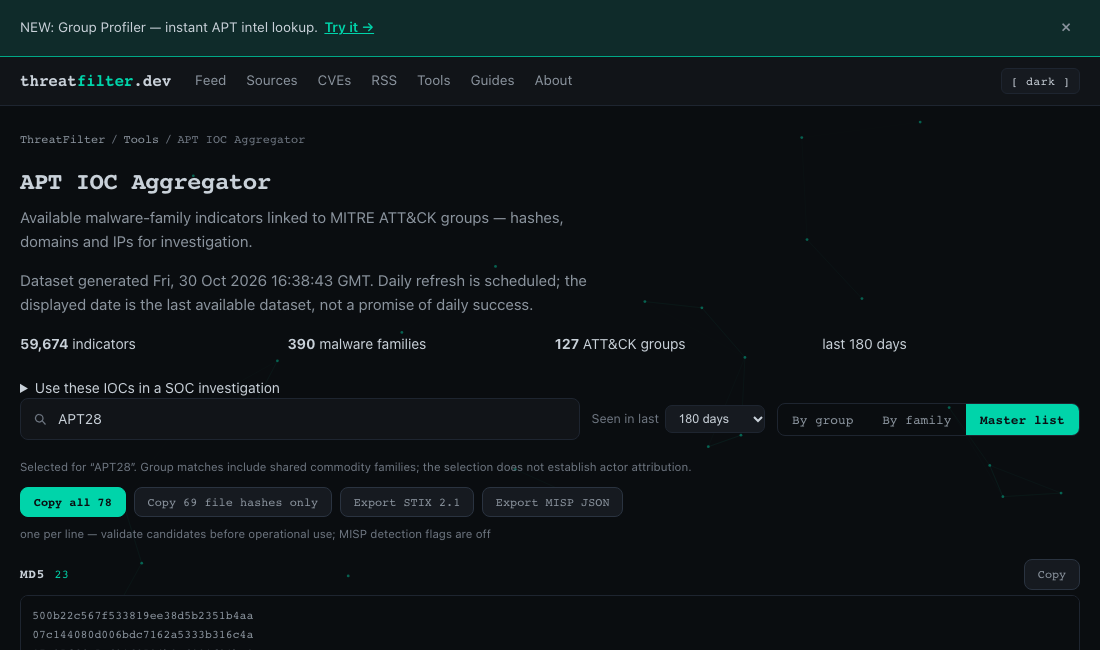
- Open the APT IOC Aggregator. Read its generation time and coverage note before selecting a group or malware family. A scheduled refresh can fail while the last good dataset stays available.
- Record the indicator exactly, its type, the reporting source and the report's observation dates when available. Preserve the original alongside any normalised value. A hash must include its algorithm; a domain and a URL are different observables.
- Read the source's surrounding analysis. Does it describe command and control, delivery, a compromised legitimate site, or simply related infrastructure? A malware-family-to-group mapping is a research lead, not evidence that every indicator belongs to that actor.
- Check whether the evidence is still relevant to your investigation period. The dataset generation date is not the indicator's first-seen or last-seen date. No result in the tool does not establish that a value is safe.
2. Look for relevant sightings in approved telemetry
Search the systems you are authorised to investigate. Record the search period, timezone, fields, data sources and any gaps. A DNS answer alone establishes a lookup; it does not show that a file ran or that credentials were stolen. For a file hash, correlate with process execution, parent process, path and endpoint identity. For a URL or domain, correlate DNS with proxy, browser or network events.
Do not visit a suspicious URL in your normal browser or submit internal documents, private URLs, customer information or secrets to a public reputation service. Use your approved analysis environment and data-sharing policy. Defang values in notes intended for casual reading.
Check alternative explanations
- Is the address shared by unrelated customers, a CDN or a public resolver?
- Did an email scanner, sandbox, security product or analyst generate the connection?
- Does the full hostname or path matter, rather than an entire service or parent domain?
- Do timestamps, device identity and a second independent telemetry source support the same sequence?
3. Choose a proportionate response and a review date
A confirmed malicious execution may justify incident escalation. A weak infrastructure match may justify a bounded hunt or further evidence collection. Before blocking, check business dependencies, expected false positives, the enforcement scope, an expiry or review date and a rollback owner. Follow your incident process rather than converting a public feed directly into a denylist.
Keep the observation separate from the conclusion: “device queried this domain” is an observation; “the device is compromised by this group” needs additional evidence. Record uncertainty and the reason for taking no action as carefully as the reason for escalating.
Worked example: a domain in a research report
Suppose a report lists download.example.invalid as a delivery host. This is a reserved, non-resolving example, not a live indicator. Your proxy records a single request from an email inspection service, with no corresponding user endpoint execution. That evidence supports reviewing the email and scanner activity; it does not by itself establish an endpoint infection.
If a second search instead finds a matching download followed by execution on a user endpoint, preserve the event identifiers and investigate using your incident procedure. Record what changed your assessment. Do not attach an actor name solely because the indicator appeared under a group in a tool.
Use the IOC triage worksheet for the source, observation period, local evidence, alternative explanation, decision and follow-up. For reviewed machine-readable transfer, continue with the STIX and MISP export guide.
Primary references and tool limits
- MITRE ATT&CK FAQ: documented behaviours, groups and the limits of technique coverage.
- CISA KEV catalogue: exploitation evidence for listed vulnerabilities, not reputation for arbitrary indicators.
- ThreatFilter coverage and freshness: retrieval status and completeness are separate.